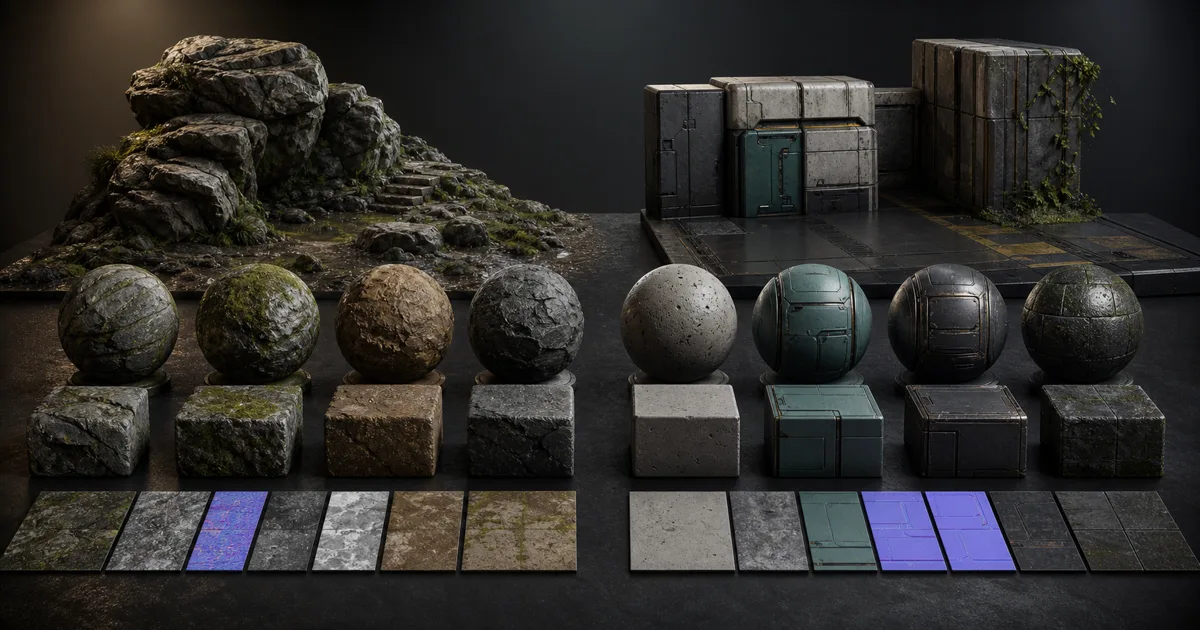
Searching for a Quixel alternative free of catalogue compromises is no longer just a hunt for another download site. Quixel Bridge is deprecated, Megascans content has moved into Fab, and the useful replacement may be a CC0 scan library, a material generator, your own camera, or a deliberately boring combination of all three. Boring combinations ship surprisingly well.
This guide separates price from permission, compares the available routes by asset type, and builds a practical workflow for surfaces that a scan catalogue cannot provide. The goal is not to declare one universal winner. It is to get the right maps into Unity, Unreal Engine, or Blender with their scale, provenance, and physical behavior intact.
Why look for a Quixel alternative free in 2026?
The product name hides two different needs. Some artists want an alternative to the Megascans library: measured rocks, ground surfaces, plants, decals, and 3D assets. Others want an alternative to the old Bridge workflow: search, acquire, export, and receive a ready material in the destination application. A useful free Quixel alternative must replace the part you actually used.
Epic currently marks the Quixel Bridge plugin as deprecated and directs users to Fab. Current Fab assets show their own price and license. Epic also states that past acquisitions generally retain the terms under which they were acquired, while assets acquired under the Fab Standard License may be used with compatible tools beyond Unreal Engine.
That means “I downloaded it from Quixel” is not enough metadata. Record the asset URL, acquisition date, license, and any source restrictions. A folder called Megascans_Final is a filing system, not legal analysis.
Choose a Quixel Megascans alternative by asset job
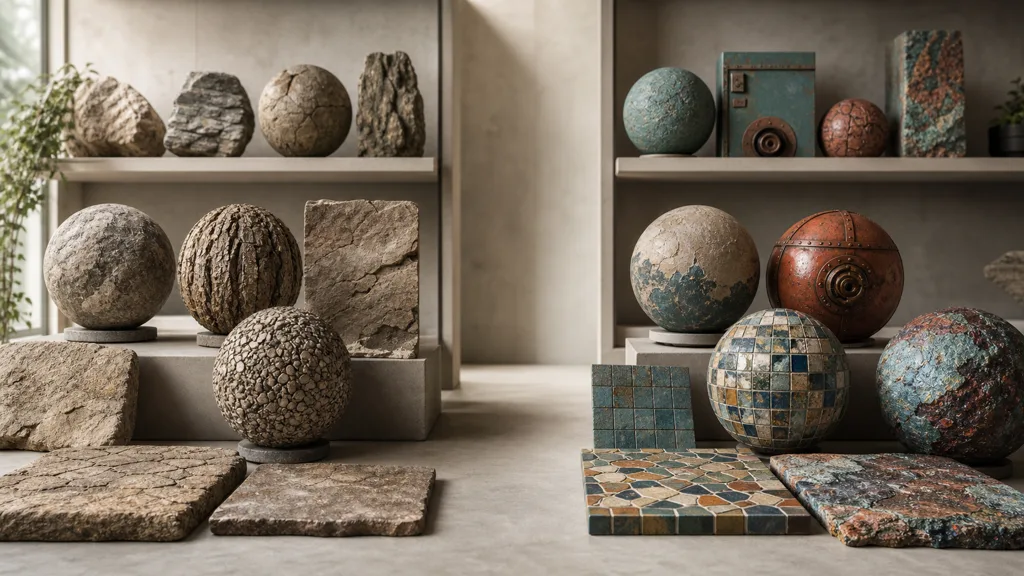
Start with the deliverable. Replacing a cliff mesh, a tileable plaster surface, and a mud decal with one service makes the comparison look tidy and the production plan worse.
- Natural 3D assets: photogrammetry libraries remain the strongest route for boulders, tree stumps, eroded ground pieces, and debris whose shape matters from several angles.
- Common tileable surfaces: CC0 libraries often cover brick, concrete, soil, wood, stone, fabric, roofing, and plaster with complete PBR maps.
- Art-directed surfaces: text-to-PBR generation fits fictional alloys, unusual paint systems, stylized geology, branded-but-logo-free architecture, and exact wear conditions.
- Surfaces you can access: photo-to-PBR turns a controlled capture into aligned maps and preserves real local variation.
- Unique props: model-specific wear still calls for baking, decals, texture painting, or a layered hybrid workflow.
A Quixel alternative for game textures does not have to replace Megascans object for object. Let scans cover reality, generation cover specificity, and painting cover authored history. Trying to make one source do all three is how a sandstone floor acquires the same memorable crack in every corridor.
Compare free Megascans alternatives without mixing licenses
The strongest Megascans alternatives differ in coverage and rights. Evaluate them as sources, not as rows in a feature contest.
| Route | Best at | Main limitation | License habit |
|---|---|---|---|
| Poly Haven | Curated scanned textures, HDRIs, and selected models | Smaller catalogue than Megascans | Assets are CC0; retain source records anyway |
| ambientCG | Broad CC0 material and environment coverage | The exact art-directed variation may not exist | Assets are CC0; store asset IDs and download dates |
| Text-to-PBR | Exact fictional or specified surfaces | Needs physical and tiling validation | Confirm the generator’s output terms; CraftPBR output is CC0 |
| Photo-to-PBR | Real surfaces available to the artist | Capture light and perspective need cleanup | Use photos you have the right to capture and reproduce |
| Fab | Megascans plus a wider marketplace | Price, format, and terms vary by listing or entitlement | Save the exact listing and acquisition license |
Poly Haven’s current license page and ambientCG both state that their assets are CC0. That is valuable for commercial work and shared source repositories, but it does not make every website with a “free” button equivalent. Free can describe a price of zero while the license still limits redistribution, attribution, clients, revenue, or engines.
Use an AI alternative to Quixel when the catalogue is almost right
Scan libraries are excellent at giving you a real wall. They are less helpful when the brief asks for this wall: pale volcanic aggregate, blue mineral paint worn by salt spray, narrow vertical trowel marks, damp only below 20 centimetres, and one metre of physical coverage. Searching can consume an afternoon while returning seventeen respectable walls that are all wrong in a different way.
An AI alternative to Quixel starts from the specification. Describe the base substance, construction, scale, age, contamination, moisture, damage distribution, and exclusions. “Old concrete” is a mood; “board-formed concrete, 1.2 m tile, dry pale cement, sparse rust bleed below tie holes, no graffiti, no dramatic shadows” is a material brief.
Generation also helps keep a material family coherent. Produce clean concrete, painted concrete, damaged paint, wet variant, and matching decal masks from one physical language. The advantage is not that the model has visited more quarries. It is that you can ask for the quarry your level designer invented on Tuesday.
Build a Quixel alternative free workflow for a missing surface
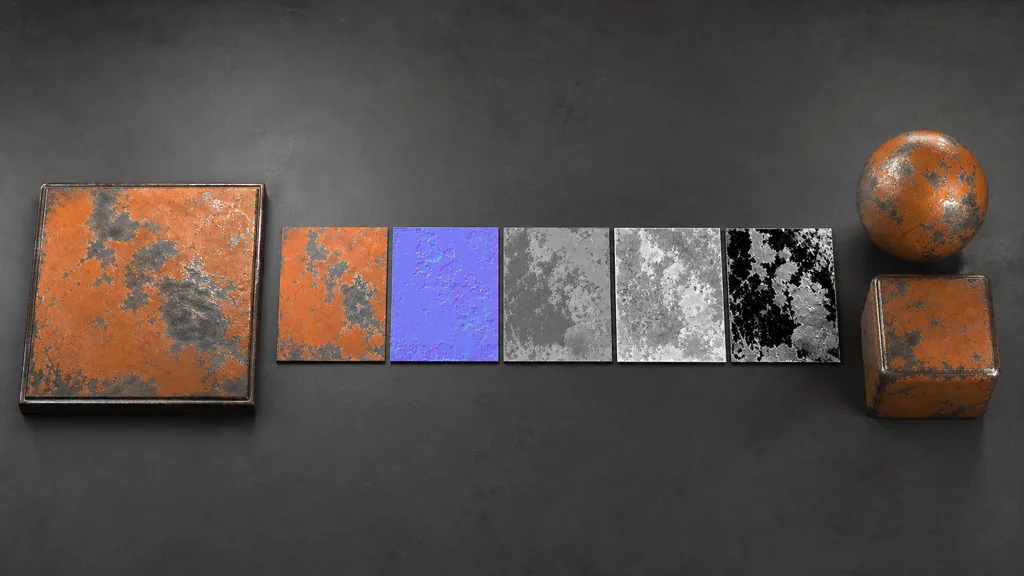
- Write the brief. Record substance, layer order, physical coverage, condition, camera distance, and target engine. Separate permanent colour from lighting.
- Search before generating. Check current Fab listings and CC0 libraries. If a suitable, correctly licensed asset already exists, use it; originality is not a production metric.
- Create the missing material. Use text-to-texture AI for a described surface or photo-to-PBR when you own a useful capture.
- Clean the set. Remove highlights and cast shadows from albedo, repair tile edges, reduce repeated landmarks, and keep every map registered.
- Check physical meaning. Roughness controls reflection spread; metalness marks exposed conductors; normal changes shading direction; height describes elevation. Brightness alone decides none of those.
- Set scale. Store metres per tile and preview at least a four-by-four repeat. A technically seamless map can still advertise its repeat with one heroic stain.
- Export and test. Produce engine-specific normals and channel packing from clean masters, then inspect the imported result under moving light.
This is the practical meaning of generate PBR textures instead of downloading scans: you replace search time with a controlled authoring pass. It is not permission to skip quality control. The generator supplies a candidate; the material lab decides whether it gets a badge.
Export a Quixel alternative for Unity, Unreal Engine, and Blender
Keep a source set with separate base colour, roughness, metalness, normal, height, and AO maps. Derive delivery formats from that set so an engine convention never contaminates the master.
- Unity: import tangent normals as Normal maps. Built-in and URP commonly combine metallic with smoothness in alpha, while HDRP uses a mask map. Follow the Unity PBR texture setup for pipeline-specific packing.
- Unreal Engine: use DirectX tangent normals by default and disable sRGB on data textures. A common ORM layout stores AO, roughness, and metalness in RGB. The Unreal texture guide covers import checks.
- Blender: use OpenGL tangent normals, route them through a Normal Map node, and mark roughness, metalness, normal, height, AO, and packed masks as Non-Color. See the Blender PBR materials guide.
A Quixel alternative for Unity or Quixel alternative for Blender is often the same source material with different delivery rules. Unreal’s close Fab integration is convenient, but a Quixel alternative for Unreal Engine still needs correct scale, channel packing, texture-group settings, and compression. Import automation can connect sockets; it cannot make the wall physically plausible on your behalf.
Validate quality, repetition, and provenance together
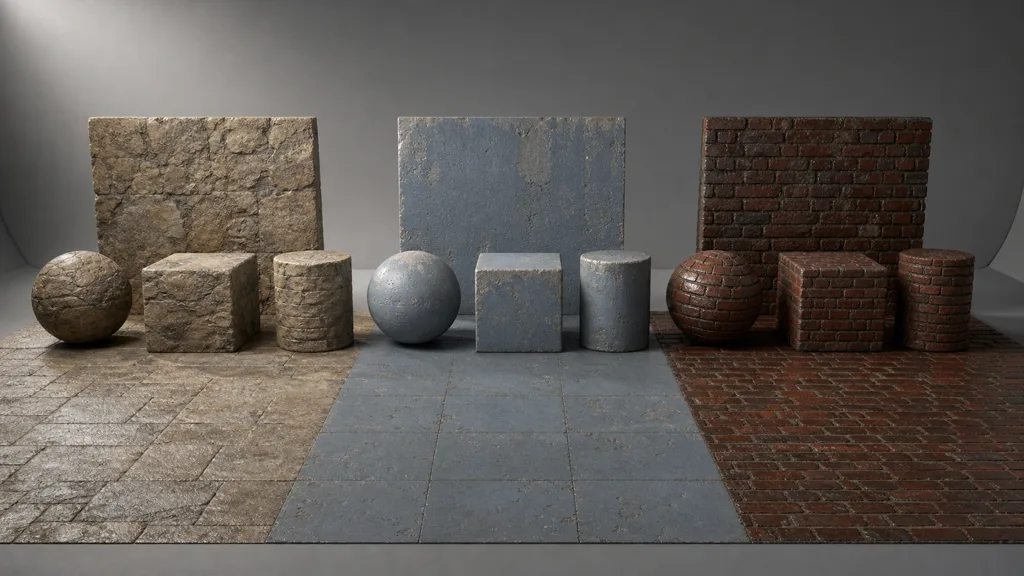
Test every Quixel Megascans alternative with the same scene. Use a sphere for reflection spread, a beveled cube for seams and tangent behavior, a cylinder for directional stretching, a repeated plane for tiling, and a real-scale reference. Rotate one area light and check the compressed engine import, not only the source PNGs.
- Does albedo remain free of fixed highlights and directional shadows?
- Do normal and height agree on which features rise and recede?
- Does roughness follow material changes rather than copied image brightness?
- Is metalness binary enough for the exposed substances?
- Does the tile preserve believable size and avoid obvious landmarks?
- Do license, source, acquisition date, and edits travel with the material?
Provenance belongs in the validation checklist because a visually perfect asset with unknown rights is not production-ready. Add a small sidecar record or material-database entry. Future teammates should not need archaeology skills to discover whether rock_07_final_final may ship.
The best free Quixel alternative is a hybrid library
Use existing scans for common natural truth. Use CC0 libraries when you want simple commercial and repository rights. Use generation for exact materials and coherent variants. Use your own captures for accessible surfaces, then reserve painting and baking for unique assets whose wear must follow geometry.
That hybrid is the best free Quixel alternative 2026 can offer: fewer forced substitutions, clearer rights, and an escape hatch when the catalogue says “close enough.” Keep masters neutral, export per engine, and validate every source by the same material standard.
Try CraftPBR
CraftPBR fills the custom-material half of a Quixel alternative free workflow:
- Text-to-PBR creates a coordinated material set from a physical surface description.
- Photo-to-PBR converts your surface capture into aligned base colour, normal, roughness, height, AO, and metalness.
- Node workspace keeps masks, ranges, tiling, and layer decisions editable.
- Engine export prepares normal orientation, map names, data settings, and channel packing.
- Free tier lets you test a complete material before adding it to the project library.
- CC0 output lets you use, modify, and ship the materials you create without attribution.
Create a custom PBR material with CraftPBR →
The library can keep the excellent rocks. You can make the wall the art director actually asked for.