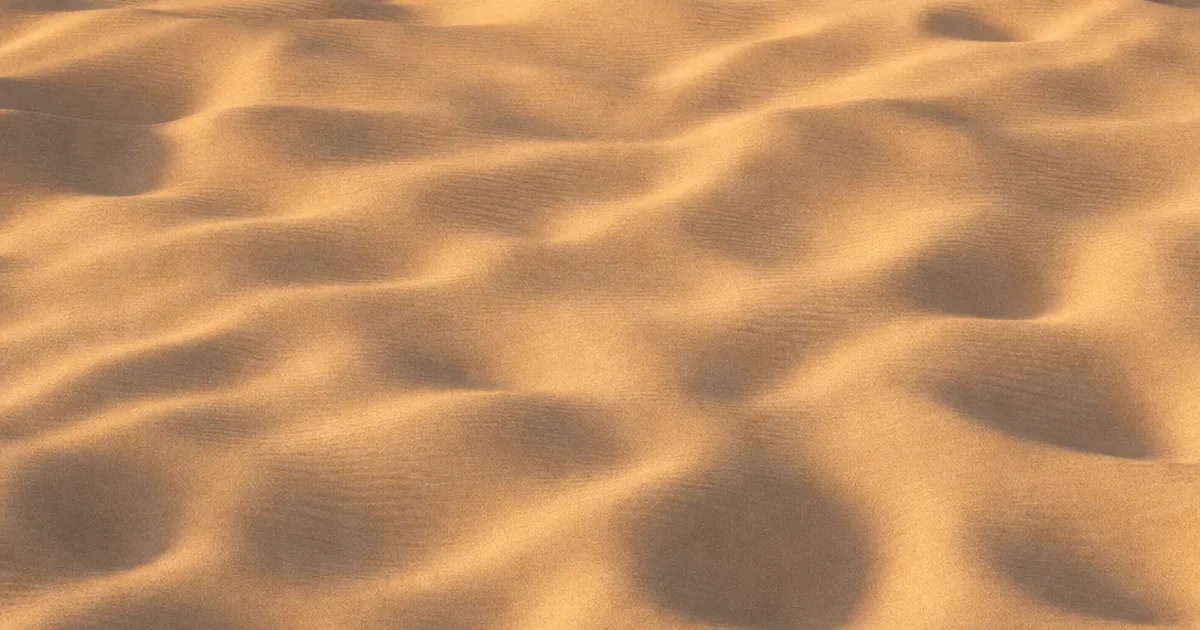
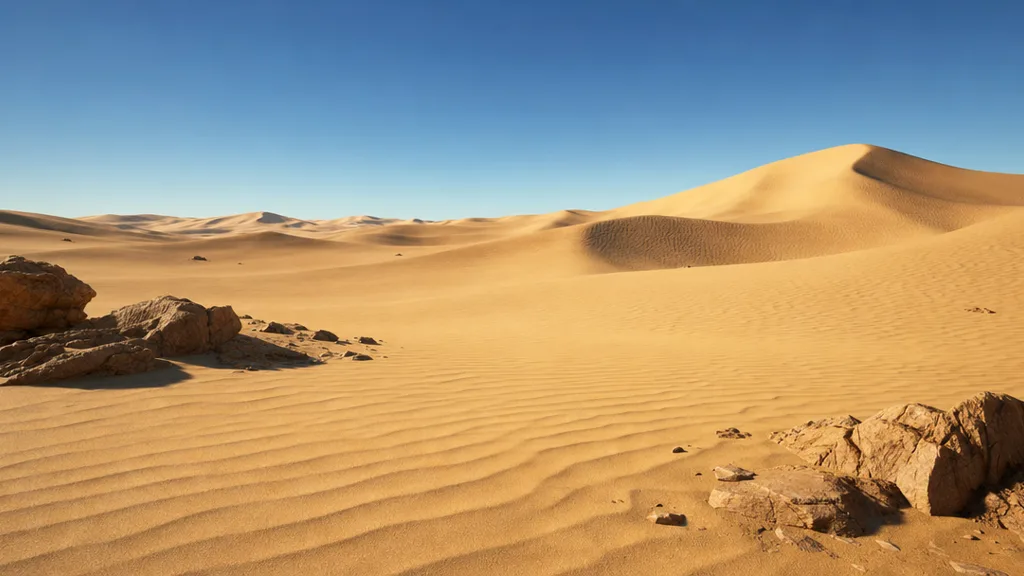
You know that feeling when your beach or desert level looks more like a flat tan bedsheet than actual sand? A seamless sand texture fixes the tiling — but sand also has to look granular and rippled. Get the grain and the ripple relief right and a single 2K tile covers an entire dune field and reads as real sand.
Sand is one of the easier materials to tile — its fine grain is forgiving high-frequency noise — but it goes flat fast without the right maps, and big ripples can betray the repeat. This guide covers what makes sand seamless, why it goes flat, and three ways to get a proper PBR sand set.
What makes a sand texture seamless?
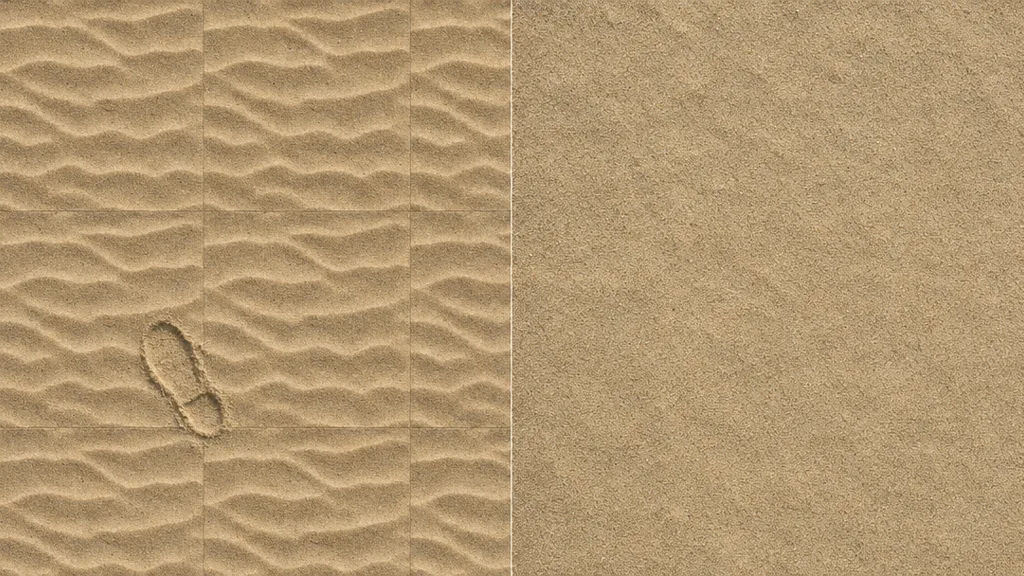
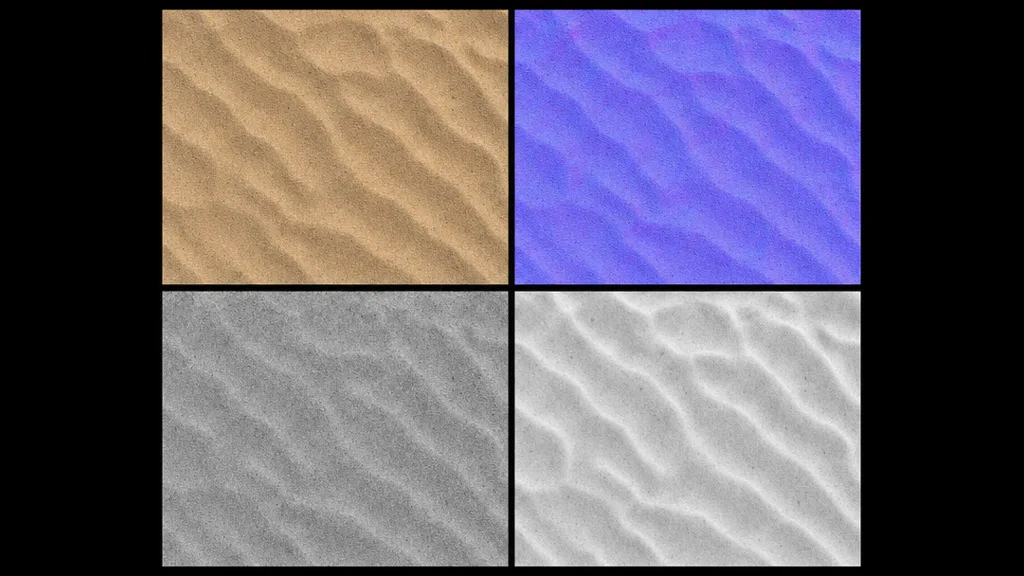
A texture is seamless when its opposite edges match — right continues into left, top into bottom. Sand wraps easily at the grain level because the detail is small and random, but the catch is the larger features: a bold ripple, a footprint, or a rock can’t repeat. A proper tileable sand texture is a full PBR set where every map wraps together — base colour, normal, roughness, and AO — or the seam shows in the grazing-light grain even when the colour tiles fine.
Why sand looks flat (and how to fix it)
Most fake-looking sand is technically seamless. It wraps fine. The problem is it has no texture relief. Here’s what kills it:
- No grain. Sand is millions of tiny grains. Without a normal map the surface is a flat sheet of colour.
- No ripples. Wind-blown sand has gentle ripples; flat sand reads as a painted plane.
- Flat roughness. Dry sand is matte, wet sand is glossy, packed sand sits between. One value flattens all of it.
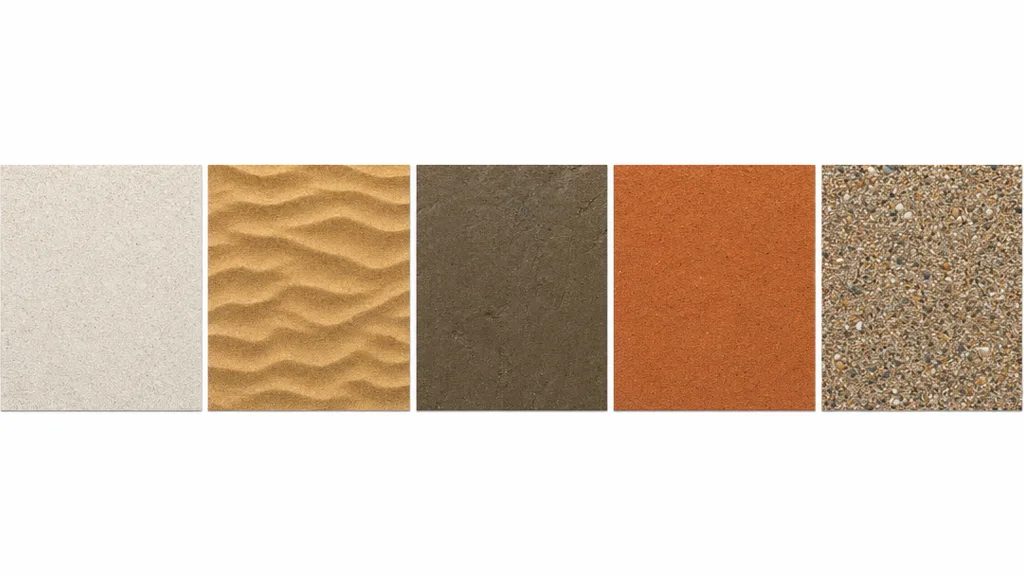
- One flat tan. Real sand has subtle tonal variation and darker damp patches. A single colour looks like cardboard.
The fix is a full PBR set: a normal map for the grain and ripples, varied roughness for dry-vs-wet, an AO map for the ripple shadow, and a touch of colour variation so it doesn’t look sprayed on.
The maps sand needs most
- Base colour (albedo) — the sand tone with subtle variation, lighting removed.
- Normal — the fine grain and ripple relief, faked without geometry. This is what catches the low desert sun. (New to these? See what a normal map is.)
- Roughness — dry matte versus wet gloss versus packed. Carries the difference between a beach waterline and a dune. (See what a roughness map is.)
- Ambient occlusion / height — shadow in the ripple dips, and real depth for dune terrain. (See what a displacement map is.)
Three ways to get a seamless sand texture
1. Heal a photo by hand
Take a flat top-down sand photo, offset it by half (Photoshop: Filter › Other › Offset, wrap-around), and heal the seam — easy with sand because the grain hides the join. Then paint out any footprint, rock, or bold ripple that would repeat. Free, quick for the colour, and you still derive the normal, roughness, and AO maps separately.
2. Download a CC0 set
Poly Haven, ambientCG, and similar libraries give you ready-made seamless sand with full PBR maps under CC0. Fast and high quality, with one limit: you get the sand that exists. A specific colour, grain size, or ripple pattern may not be in the catalogue.
3. Generate it from a prompt
Describe the sand — “fine white beach sand, damp near the waterline” — and let AI build a tileable PBR set already wrapped. CraftPBR generates the base colour and derives a matching normal, roughness, AO, and height, then makes the set seamless together. You get the exact sand you described, in about a minute — the same text to texture workflow, pointed at the dunes.
Killing the grid: break up the repetition
Even a perfect seamless sand texture repeats across terrain bigger than the tile. The standard tricks:
- Add a macro variation map — large, faint noise that drifts whole regions lighter and darker, like damp and dry patches.
- Scatter detail meshes — pebbles, shells, footprints, grass tufts placed on top, not on a tiling grid.
- Use displacement for dunes so the big shapes come from geometry, not the tile.
- Use a stochastic/hex-tiling node (Unreal, Blender) — sand hides stochastic tiling beautifully because it’s already random.
For the full anti-repetition toolkit across every material, the seamless tileable textures guide goes deep.
Seamless sand texture in Unity, Unreal, Blender, and Godot
- Unity — Wrap Mode Repeat, base colour sRGB, normal/roughness/AO as linear (Non-Color). The terrain system layers sand with splatmaps; use Tiling to scale the grain.
- Unreal — Landscape Material with the sand maps, and remember Unreal expects DirectX normals — flip the green channel if yours are OpenGL. Add displacement for dune silhouettes.
- Blender — Image Texture nodes set to Repeat, base colour sRGB and the rest Non-Color, into a Principled BSDF; add height via adaptive subdivision for dunes. Blender uses OpenGL normals.
- Godot — assign the maps in a StandardMaterial3D, enable AO, set UV1 scale to tile. Godot uses OpenGL normals like Blender.
Key takeaways
- Sand tiles easily at the grain level — its fine detail is forgiving high-frequency noise
- The trap is the big features: a footprint, rock, or bold ripple that repeats gives the grid away
- The “flat sand” look is missing grain relief, no ripples, and flat roughness, not a bad photo
- The normal map carries the grain and ripples; roughness separates dry matte from wet gloss
- Break up repetition with macro variation, scattered detail meshes, and displacement for dunes
- It imports into any engine — just mind the OpenGL/DirectX normal convention