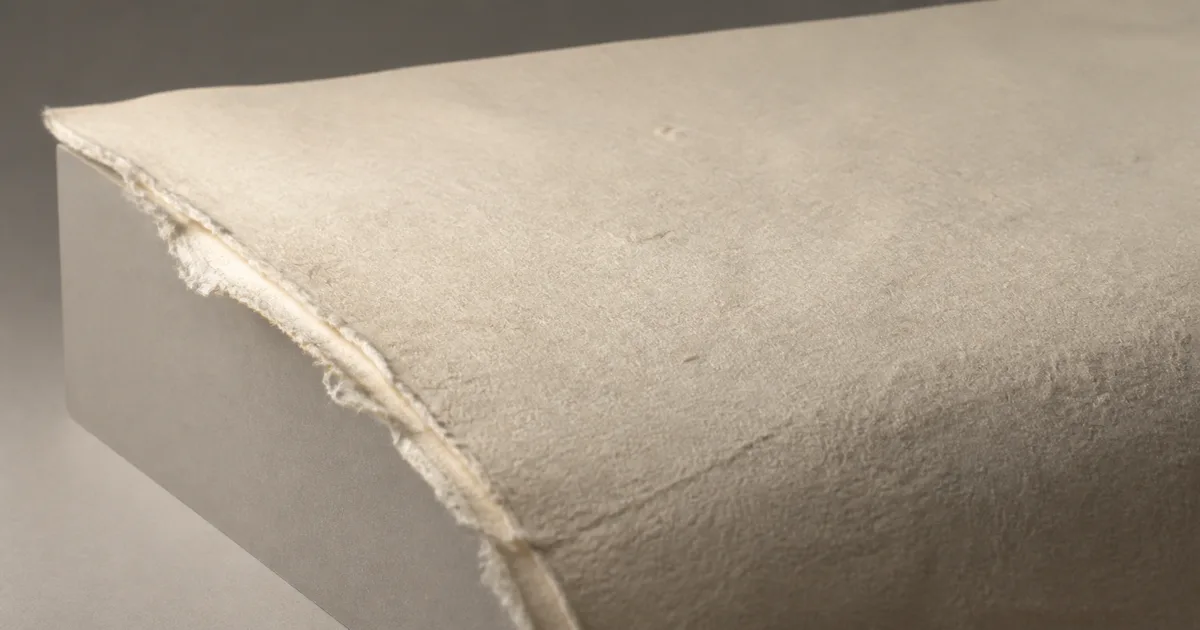
A seamless paper texture has to keep the tiny evidence that makes paper feel physical while removing the larger evidence that reveals a repeated image. Fibers, shallow dents, pulp density, sizing, compression, and age can all belong. A memorable dark fleck appearing every thirty centimetres does not.
This guide builds a seamless paper texture as a measured surface: choose the stock, capture or generate neutral source data, separate physical signals into PBR maps, repair the repeat without sterilizing it, and decide which deformation belongs in textures versus geometry.
Start with the paper stock, not the color picker
The stock behind a seamless paper texture can have very different construction. Hot-press cotton paper is compressed smooth. Cold-press watercolor stock keeps a shallow tooth. Laid paper can show directional chain and laid lines. Recycled paper may contain colored flecks and uneven pulp. Handmade sheets can have long visible fibers, inclusions, thickness variation, and deckled edges.
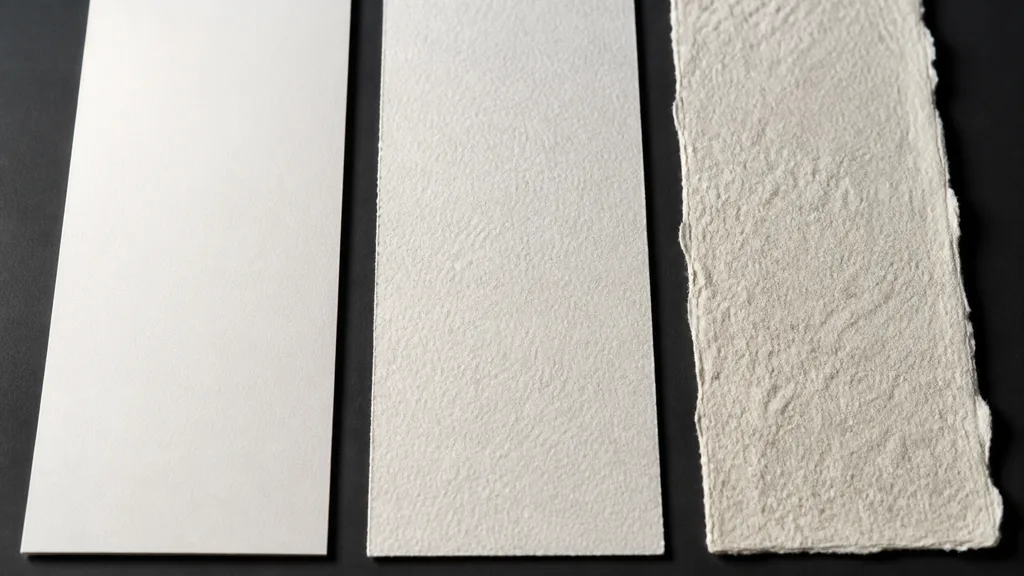
Write a compact material brief before making maps:
- fiber source: wood pulp, cotton rag, recycled pulp, mulberry, or a deliberate blend;
- formation: machine-made, mould-made, or handmade;
- surface: hot-press, cold-press, rough, coated, calendared, or embossed;
- weight and thickness: ordinary copy stock, card, board, tissue, or heavy art paper;
- condition: new, handled, sun-aged, water-marked, folded, dusty, or foxed;
- viewing distance: close product shot, book prop, wall covering, game pickup, or broad environment.
Compression changes relief, coatings alter roughness, and thickness decides whether a bent sheet needs geometry. Record the scan DPI or physical coverage too: plausible 0.2 mm fibers become straw when mapped at the wrong scale.
Capture a scanned paper texture without capturing the lamp
A flatbed scanner can source a seamless paper texture because it keeps the surface square to the sensor and delivers consistent scale. It is less useful when its moving light exaggerates gloss, crushes shallow relief, or creates directional shadows.
For a clean scanned paper texture, start with a sheet larger than the required crop. Clean the scanner glass, disable automatic sharpening and contrast, capture at a bit depth that preserves gentle tonal changes, and include an unprinted margin. Rotate the paper 180 degrees and scan again if you need to identify lighting or sensor bias: real fibers rotate with the sheet; scanner artifacts do not.
Do not bake folds, hard cast shadows, or a yellow room light into base color unless the material is meant to contain a specific stain. A tileable paper texture is reusable precisely because illumination remains the renderer’s job. The source should describe cellulose and finish, not the photographer leaning over it.
Build a paper PBR texture by physical cause
A seamless paper texture is nonmetallic, usually rough, and shallow in relief, but those broad truths do not make every map identical. Build each channel from the same physical surface while allowing it to answer a different question.
| Map | Describe | Avoid |
|---|---|---|
| Base color | Pulp color, restrained fiber tint, age, stains, inclusions | Scanner shadows, highlights, black creases |
| Roughness | Coating, sizing, compression, handling polish, moisture | Copied grayscale albedo |
| Normal | Fine fiber relief, tooth, tiny dents, shallow embossing | Deep cloth weave or inflated fibers |
| Height | Broad cockling, pressed texture, folds where appropriate | Turning every speck into a spike |
| Ambient occlusion | Restrained contact in deep embossing or creases | Outlining ordinary fibers in black |
| Metalness | Zero | Variation from color noise |
In a seamless paper texture, the paper roughness map often carries more identity than expected. Uncoated cotton stock scatters reflections broadly. Calendared or coated paper has a smoother response. Repeated handling can polish high areas and edges. A damp patch may darken base color and temporarily change roughness, but it should not be represented by simply inverting the image.
A paper normal map should be quiet at ordinary distance and informative under grazing light. Derive fine normals from a cleaned height source, then remove broad capture gradients. Test the normal strength on a plane at real scale. If individual fibers cast theatrical blue-purple ridges in the map, the renderer will make stationery look structurally ambitious.
For a seamless paper texture, use fine height for tooth, medium height for pulp variation, and a separate layer for wrinkles or folds. The normal map guide explains tangent-space detail, while the displacement map guide covers when height should move geometry.
Store roughness, normal, height, and masks as linear data. Base color uses color-space sampling. The roughness map guide covers the difference; a gamma correction applied to height can make subtle paper relief arrive in the shader with a new and unhelpful opinion.
Make a seamless paper texture without erasing every fiber
A seamless paper texture needs matching borders, but a technically wrapping image can still repeat loudly. Dark inclusions, curved fibers, pulp clouds, watermarks, and creases become landmarks. The eye does not need a visible seam if the same bent fiber forms a regiment across the surface.
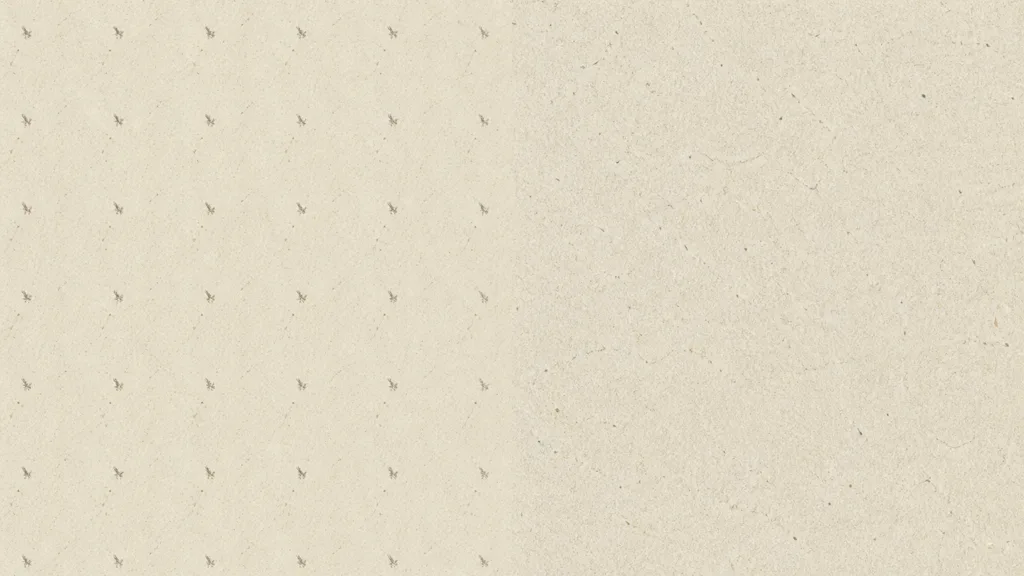
Work in three passes:
- Repair the borders. Offset the source by half its width and height, then clone or heal across the new central cross. Apply corresponding repairs to height and roughness rather than fixing color alone.
- Remove landmarks. Preview at least an 8-by-8 repeat. Replace distinctive flecks, loops, stains, or tonal islands while keeping the general fiber density.
- Restore natural statistics. Add restrained, non-memorable variation at fine and medium scales. A perfectly uniform field is not the goal; an untraceable distribution is.
Check each map separately. Base color may tile cleanly while a bright roughness patch repeats under a moving light. A normal-map seam can hide when the light is frontal and become a ruler-straight ridge at grazing angles. The broader seamless tileable textures guide covers border repair across coordinated sets.
A directional seamless paper texture needs extra care. For a handmade paper texture seamless result, preserve local fiber direction but remove any one fiber long enough to become a map reference.
Keep wrinkles and edges out of the base tile
A wrinkled paper texture seamless can be useful for a crushed sheet, parcel, label, or old document, but strong wrinkles rarely belong in the base seamless paper texture. Each crease contains a unique path, change in normal direction, compression, and often a permanent color or roughness response. Repeat that path and the sheet looks stamped.
Separate material identity from object history:
- keep fibers, tooth, coating, and small random dents in the repeating material;
- put major folds and cockling in a second large-scale height or normal layer;
- use decals or unique masks for stains, foxing, print, tape residue, and handling;
- model rolled edges, silhouettes, layered corners, and deep folds;
- add a thickness or subsurface treatment only when the shot and engine justify it.
Torn and deckled edges are geometry problems at close range. A flat opacity mask can cut the outline for a game prop, but it cannot show the layered fiber thickness from every angle. Model or displace the edge where it catches light. Keep the center material reusable.
A production pass from source to seamless paper texture
Use this sequence when deciding how to make paper texture seamless without flattening its construction:
- Specify the stock. Record pulp, manufacture, finish, weight, condition, physical coverage, and target camera distance.
- Capture or generate neutral source data. Keep perspective square, lighting diffuse, scale known, and print or props out of the frame.
- Neutralize illumination. Remove broad gradients, cast shadows, scanner streaks, and clipped highlights while preserving genuine pulp variation.
- Separate frequency bands. Isolate fine fibers, medium tooth, broad pulp density, and any object-scale folds so each can be controlled independently.
- Build the PBR channels. Author color, roughness, normal, and restrained height from physical causes; keep metalness at zero.
- Repair the tile as a set. Offset every aligned map, heal borders, and confirm that directional features cross with matching values and orientation.
- Remove repeat landmarks. Inspect a large tiled field under flat and grazing light, replacing memorable flecks, loops, and roughness patches.
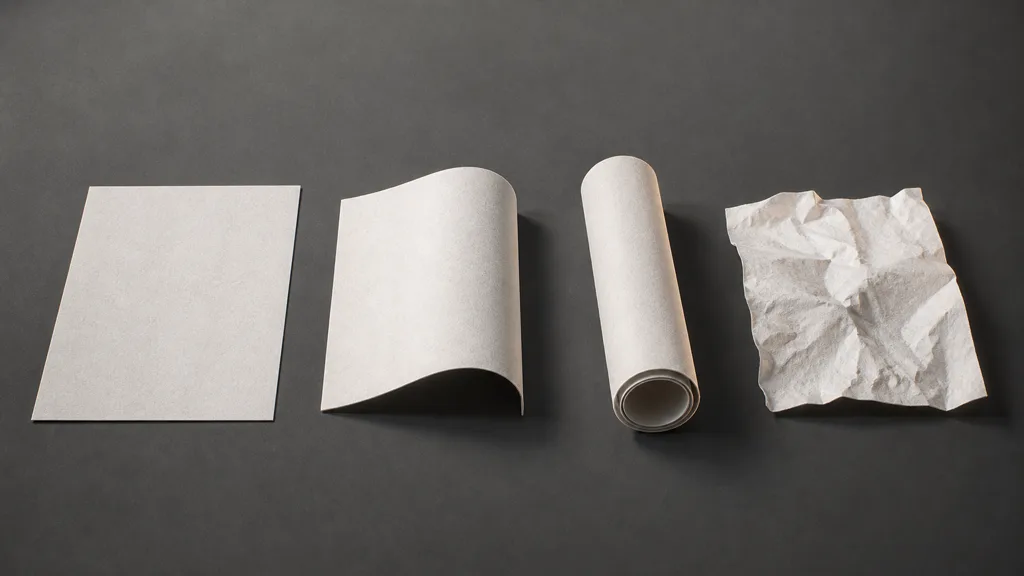
- Validate on deformed geometry. Test the material on a plane, bend, roll, and crumpled form at real scale, then adjust filtering and strength for the target engine.
Start from a physical paper description
Generate aligned paper PBR maps, then refine fiber scale, tile cleanup, height, and finish in the node workspace.
Create a paper material →Paper texture setup in Unity, Unreal Engine, and Blender
The same seamless paper texture needs destination-specific import settings. For a paper texture Unity material, import base color as sRGB and numeric maps as linear data. Export the intended roughness or smoothness channel layout, use double-sided shading only when needed, and remember that disabling back-face culling does not create thickness.
For a paper texture Unreal Engine setup, keep numeric maps linear, feed roughness directly, keep metallic at zero, and use realistic normal strength. Two-sided shading helps thin props; specialized subsurface treatments need testing because paper is not a leaf with office supplies.
For a paper texture Blender material, use Principled BSDF, a Normal Map node, and restrained bump or displacement. Give hero sheets actual thickness, then test them under broad and grazing light.
Across all three, set the tile in physical units. Enable enough anisotropic filtering for oblique sheets, inspect mip behavior, and keep unique print separate from the reusable material. Text printed inside base color turns every paper variation into a new texture set; a decal, layered material, or unique albedo overlay usually gives better mileage.
Diagnose why a paper texture looks flat or fake
When asking why does paper texture look flat, test the seamless paper texture one signal at a time instead of raising every slider.
| Symptom | Likely cause | Better test |
|---|---|---|
| Paper looks like plastic | Roughness too low or too uniform | Sweep a broad light across the surface |
| Paper looks like plaster | Normal or height too strong | Check real scale on a flat plane |
| Paper looks like fabric | Fibers form an invented regular weave | Compare against a macro reference of the stock |
| Repetition appears at distance | Memorable flecks or pulp clouds | Inspect an 8-by-8 tile in base color and roughness |
| Surface seam appears under light | Normal or height borders disagree | Rotate a grazing light around the tile |
| Folds look stamped | Unique wrinkles baked into repeating maps | Move folds to object-scale masks or geometry |
| Edges look infinitely thin | Two-sided plane has no modeled thickness | Inspect a rolled or torn edge in silhouette |
| Fine fibers sparkle | High-frequency normals exceed pixel coverage | Soften micro-detail and inspect the mip chain |
The best paper texture 2026 is not the one with the most visible fibers in a thumbnail. It is the one whose stock remains identifiable at the approved camera distance, whose repeat disappears across the actual surface area, and whose edges and deformation receive the geometry they require.
FAQ
How do you make a seamless paper texture?
Capture or generate a neutral paper source, remove lighting gradients, and build aligned color, roughness, normal, and height maps. Offset all maps together, repair the borders, then inspect a large tiled field and remove recurring fibers or pulp clouds that reveal the repeat.
Can paper have a normal map?
Yes. A paper normal map can describe shallow tooth, fibers, dents, and fine pressed detail without extra geometry. Keep the strength restrained and test at real scale, because exaggerated fibers quickly make paper resemble cloth or plaster.
What roughness value should paper use?
There is no single value for every stock. Uncoated and rough papers are generally quite rough, while coated, sized, calendared, or handled areas can show a tighter grazing reflection; use a measured range and vary it by physical finish.
How do I scan paper for a texture?
Use a clean scanner, disable automatic sharpening and contrast, include more source area than the final crop, and record the scan DPI. A second scan with the sheet rotated can help distinguish real paper features from scanner streaks or illumination bias.
Should paper folds be in the texture or geometry?
Fine compression and shallow wrinkles can live in normal or height maps. Deep folds, rolled edges, torn silhouettes, and bends that affect shadows or outline should use geometry, with unique masks layered over the seamless paper material.
Why does my seamless paper texture still repeat?
Matching borders removes seams but does not remove internal landmarks. Tile the material broadly and replace distinctive dark fibers, stains, loops, tonal clouds, and roughness patches that recur at regular intervals.
Is paper metallic in a PBR material?
No. Ordinary paper and its common coatings should use zero metalness. Metallic foil, ink, or attached leaf is a separate material region and should be masked independently from the paper substrate.
Try CraftPBR
CraftPBR helps turn a stock description or controlled reference into a coordinated seamless paper texture:
- Text-to-PBR generates a complete paper material from a physical description of pulp, finish, fibers, age, and surface tooth.
- Photo-to-PBR converts a controlled paper scan or photograph into aligned material maps.
- Node workspace keeps fiber scale, tile cleanup, roughness, height, color balance, and variants editable.
- Engine export prepares normal orientation, roughness or smoothness, channel packing, and filenames for common destinations.
- Free tier lets you build and validate a complete paper material before committing it to a prop or scene.
- CC0 output lets you modify, render, and ship generated textures without attribution.
Keep the fibers. Lose the repeat.
Create a complete paper PBR material from text or a controlled scan, then export it for your renderer.
Create a seamless paper material →Keep the fibers irregular. Let the tile be the least memorable part.